
Farnborough 2026 — Day 1 Field Notes
Day 1 at Farnborough International Airshow 2026: $48.8B in aircraft orders, defense at half of exhibitors, and what our aerospace clients were actually asking.
Farnborough 2026 — Day 1 Field Notes
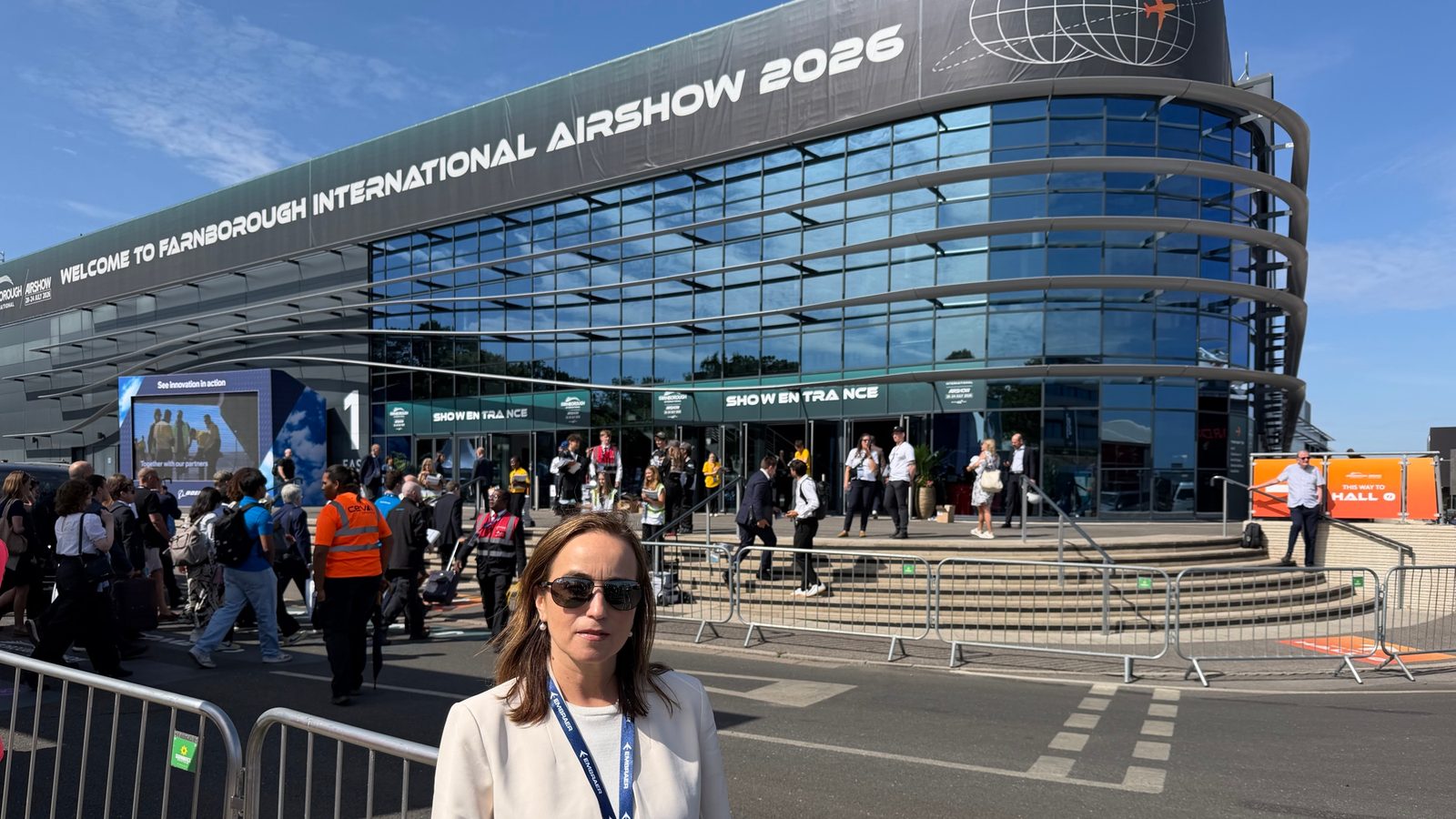
Farnborough, 20 July 2026. The show opened under clear skies and a record footprint — 1,600 exhibitors, a new sixth exhibition hall, a first-of-its-kind Aerospace Global Forum Finance Summit, and defense companies accounting for half of the exhibitor list. By the time the gates closed, ADS Group had tallied 234 firm commercial aircraft orders and 466 firm engine orders, a combined $48.8 billion at list prices — the strongest opening day the show has seen since 2018.
The commercial headline belonged to SMBC Aviation Capital’s split narrowbody order: 100 Boeing 737 MAX aircraft and 100 Airbus A320neo-family aircraft on the same day, the first time the lessor has taken the 737-10 into its book. Riyadh Air exercised options for 28 more Boeing 787s and six additional A350-1000s. Philippine Airlines committed to up to 20 787-10s — its first Boeing widebody order in eighty years of partnership.
Engines shifted too. British Airways selected Pratt & Whitney GTF for up to 63 A320neo-family aircraft — a switch from the CFM LEAP-1A that powers its existing narrowbody fleet, creating a mixed-engine operation and a hiring signature that will be felt in the maintenance and technical-leadership market for years. BOC Aviation placed its largest-ever engine order, up to 300 CFM LEAPs.
For those of us at Farnborough on behalf of manufacturing and aerospace clients, the tone of the private conversations mattered as much as the headlines. Three threads came up repeatedly in the first day.
1. The Mexico question is now a program-transfer question
Two years ago, the conversation about Mexico centered on capacity and site selection. This year, in chalet meetings and coffees on the periphery of the show, it centered on who runs the plant when a program actually moves. The specifics are unglamorous and revealing: how a bilingual technical vice president is developed rather than imported; how a certifying authority — FAA, EASA, ANAC, AFAC — reads the bench a plant presents; how a program manager in the Bajío maintains a defensible line to a European or North American parent when the reporting matrix crosses three time zones.
The market has moved past “does Mexico have the talent?” The question is now sharper: which corridor, which sub-sector, which prior program, and how the retained search is structured when the reporting line is genuinely matrixed. That is the conversation we came to Farnborough to have.
2. Defense is now inside the aerospace hiring conversation
The exhibitor split — defense at roughly half of 1,600 companies — is not a statistic. It is a structural change in what an aerospace leadership profile looks like. Archer Aviation and Anduril unveiled Thunder, a jointly-developed autonomous Group 5 VTOL platform, on the first day of the show — a defense variant built on Archer’s commercial air-taxi engineering. Lockheed Martin used the opening day to announce a lower-cost Patriot interceptor. The line between commercial aerospace and defense engineering — never as clean as the org charts suggest — has moved again.
For a manufacturing-executive-search practice serving Mexico, this matters concretely. It changes what “aerospace experience” means on a CV. It widens the pool of profiles worth evaluating for a next-generation manufacturing leadership role — and it narrows the pool of profiles that are truly export-controlled.
3. Mexico’s own presence was quieter but consequential
Aeropuertos y Servicios Auxiliares (ASA) used the show to reaffirm its role in Mexico’s national Sustainable Aviation Fuels (SAF) roadmap — a reminder that the Mexican aerospace story is not only about maquiladora assembly for OEMs abroad, but about a domestic industrial and energy build-out that has its own leadership needs. Honeywell announced a partnership with Aeroméxico to deploy SURF-A runway safety technology across more than 100 Boeing 737 jets, a substantial technology commitment from a Mexican flag carrier that has come through restructuring with a sharper technical agenda.
Neither headline is the biggest of the day. Both matter for how leadership hiring conversations in Mexico will be framed for the next twelve months.
What we’re watching for the rest of the week
The rhythm of the show typically shifts on Tuesday from commercial-order theatre toward defense and technology announcements — the Aerospace Global Forum Defense Summit is scheduled for Day 2. We will be at Farnborough through Wednesday, and continue to have limited availability for private conversations with clients and candidates who prefer to talk in person about what these opening-day signals mean for their leadership plans.
We will publish a second set of field notes at the close of the show.
By Silvia Flores, Managing Partner at Alder Koten, leading executive search for manufacturing, supply chain, and industrial sales in Mexico. Alder Koten is a member of the IMD International Search Group, whose Aerospace Practice is represented at Farnborough 2026.
If you would like to arrange a conversation before we leave the show, please contact us.