
Farnborough 2026 — Day 5 Field Notes
Closing dispatch from Farnborough: $84B in deals, autonomy on every serious stand, and a hybrid-electric Ohio plant that is the manufacturing story of 2026.
Farnborough 2026 — Day 5 Field Notes
Farnborough, 24 July 2026. The show closed as it began: with a queue at the Electra chalet, a wing of aircraft models under afternoon light, and a set of conversations that only make sense if you accept that the aerospace industry, the ground-mobility industry, and the industrial-automation industry are converging into a single manufacturing conversation. That is what changed in this show.
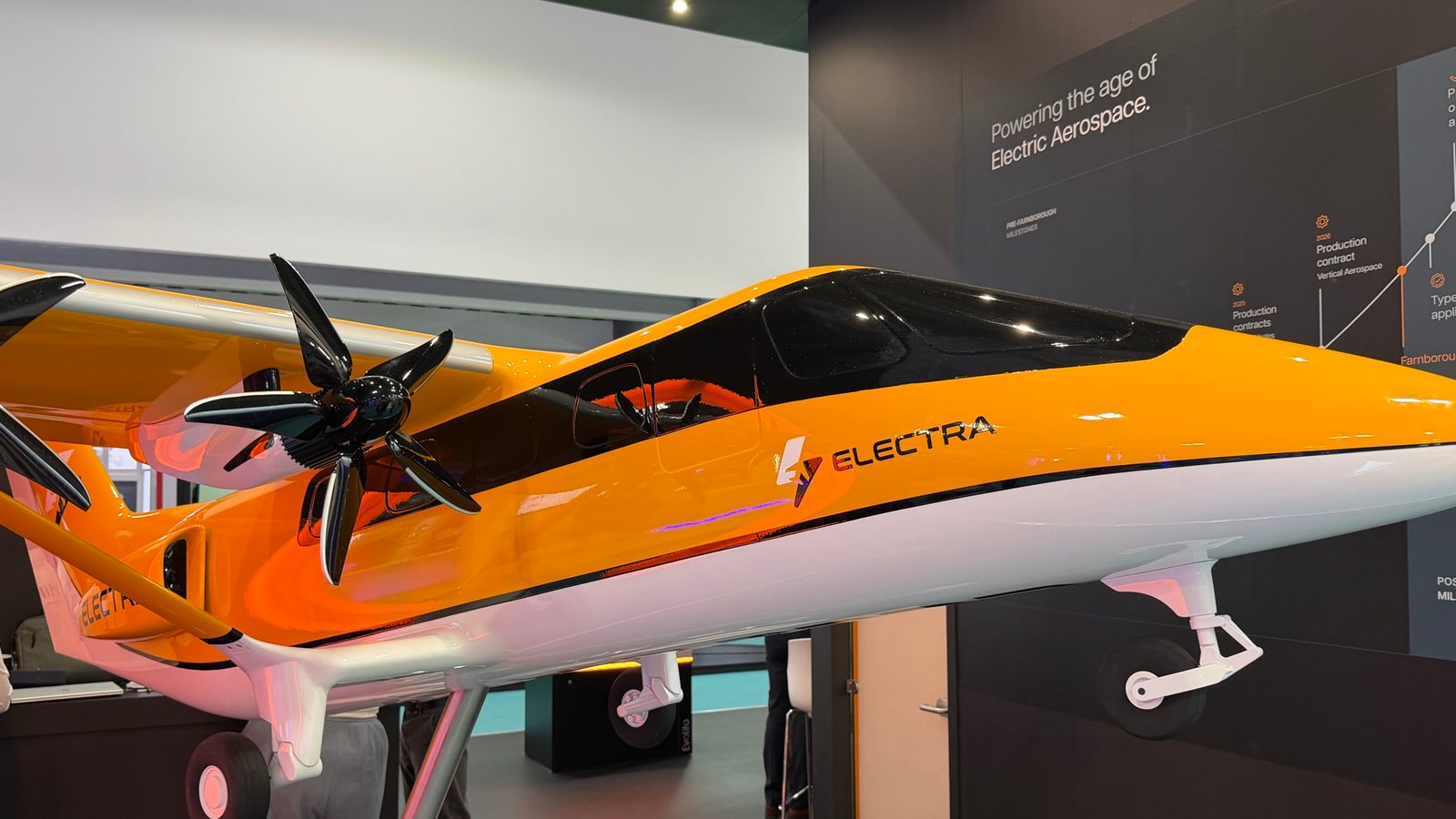
The photo above is the anchor. Silvia stood in front of the Electra EL9 hybrid-electric ultra-STOL at the closing day’s press flow. Behind the aircraft, Electra’s program-milestones wall reads Powering the age of Electric Aerospace — Farnborough listed among the milestones. Three days earlier, on Day 2 of the show, the company had announced its $850 million EL9 assembly plant in Springfield, Ohio, a 96-acre greenfield facility next to Springfield-Beckley Municipal Airport, targeting 400 aircraft per year at initial capacity and 800 at build-out, with roughly 2,000 direct jobs in Clark County. Governor Mike DeWine attended the announcement alongside Electra CEO Marc Allen. The site was chosen from 140 candidate locations across the United States on workforce availability, infrastructure readiness, and long-term expansion room.
That announcement is the manufacturing story of Farnborough 2026 in one project — and it is the same story the show told from a dozen other stands.
The closing numbers
ADS put the four-day total value of deals at £62.9 billion (approximately $84.4 billion) through Thursday close, with an estimated £10.8 billion of UK content associated with the orders, according to ADS Advance. Airbus, Boeing, and Embraer secured 353 firm aircraft orders during the four trade days, with an additional 12 options placed with Airbus and Boeing. Engine manufacturers recorded 904 firm engine orders across CFM’s LEAP family, Pratt & Whitney, and GE Aerospace, plus 60 P&W options. The show also generated firm orders for 10 Airbus helicopters. India Strategic reported 327 firm aircraft orders across the three official business days, with SMBC Aviation Capital’s 200-narrowbody order (100 Boeing 737 MAX + 100 A320neo family) accounting for well over half.
Friday’s final trade day added smaller but meaningful items: MTU Aero Engines confirmed roughly $500 million in Farnborough orders, with Pratt & Whitney GTFs going to British Airways, Tigerair Taiwan, and Jackson Square Aviation on A320neo-family aircraft, and PW1900G engines going to Abra Group, Binter, and Luxair on Embraer E2s. Safran Landing Systems and Lufthansa Technik signed a ten-year support agreement covering landing gear and hydraulic equipment for the A320, A330, A340, and A350 fleets. THC’s Bombardier LOI, announced earlier in the week, was formalized as a firm order for 12 aircraft with an option for 48 more.
Autonomy was on every serious stand
The Farnborough 2026 stand map read differently than 2024’s. The largest CCAA (Collaborative Combat Aircraft) and autonomy stands were not in a “future of aviation” pavilion at the back — they were on the main halls, next to the E2 mock-ups and the LEAP cutaways. Autonomy has moved from adjacent-technology to line-of-business.
The public headlines from the four defense-and-autonomy days: BAE Systems’ Bronte Max, Britain’s first autonomous collaborative combat aircraft, roughly the size of a Hawk trainer, designed to fly alongside Typhoon, F-35, and the future Tempest as an electronic-warfare and precision-strike node. BAE also unveiled Black Thorn, a modular warhead across three sizes that plugs into drones, missiles, counter-drone interceptors, and other autonomous systems — selected for Frankenstein Technologies’ low-cost Mark 1 air-defence missile. Boeing showcased the MQ-28 Ghost Bat for European rearmament, teaming with Rheinmetall in Germany to integrate the MQ-28 into the Luftwaffe with a target availability of 2029. BETA Technologies introduced the ALIA MV250, an autonomously controlled hybrid VTOL utility aircraft with a 2,000-lb payload and 250-nm range at full payload. TEKEVER unveiled its AR6 autonomous heavy-lift family for civil-logistics and forward-military use. Vertical Aerospace flew the first piloted eVTOL at Farnborough and moved into advanced discussions with the UK government on a support package (up to £10 million grant funding) to anchor Valo production in the UK. Embraer and Anduril’s Barracuda-500M / C-390 announcement earlier in the week sat inside the same trend.
Underneath the announcements, the pattern is: autonomy is showing up simultaneously in the product and in the plant. The Ghost Bat and the Bronte Max are autonomous products. The Ohio Electra factory, the UK Vertical Aerospace assembly plant, the Beehive Industries 3D-printed-engine expansion (announced Day 2, also in Ohio) are advanced-automation manufacturing plants — high-mix, small-batch, robotics-heavy, digital-twin-driven, engineered for a workforce that manages autonomous production cells rather than manual assembly lines. This is the convergence.
What the closing conversations were really about
The Friday conversations at Farnborough kept returning to the same operational question: the plant leader you hired in 2019 is not the plant leader you need in 2029. Ten years ago the profile was a strong ISO-driven Six Sigma operator with a bilingual capacity and 400 people on the floor. Today it is an engineer-manager who can hold a matrixed P&L across a digital-twin production line, an autonomous inspection layer, an AI-quality function, a certification-authority reporting cadence, and a supply chain that has to shift 15% of source content on 60 days’ notice.
Mexico sits at the center of this shift, and the shift is the reason a divergent Mexican industrial market — record export tier expanding, IMMEX employment contracting for a fifth consecutive year — is a positive signal, not a contradiction. The plants that are hiring today are the plants that have crossed into that new leadership profile. The plants that are contracting are the plants that did not. The corridors that will define Mexico’s next decade — Bajío for aerospace and automotive tier-ones, Monterrey for heavy industry, the border for cross-border integrated defense-adjacent production — will map exactly to which plants made the profile transition.
Bilateral conversations on Friday also returned repeatedly to the ITAR/export-control question we flagged from Day 2. As autonomous and dual-use programs move into Mexican corridors — and they will, because the platforms need production scale that fits Mexico’s economics — the screening question for plant leaders and engineering leads will not be are they capable but are they clearable, and can they lead cleared teams alongside non-cleared teams inside the same operation. That is a scarcer profile than the current market fully appreciates, and the plants that build the pipeline first will win the programs.
Where the story continues — SAE Detroit, then CES Las Vegas
The mobility story does not end at Farnborough. Two conversations we started here continue at SAE International’s shows in Detroit — the industry’s canonical venue for automotive engineering, autonomous ground systems, and the intersection of aerospace and automotive powertrains — and at CES in Las Vegas in January 2027, where every serious mobility platform, from autonomous freight vehicles to eVTOL flight-control systems to embedded-AI silicon, now positions itself.
The through-line will be the same one we tracked at Farnborough: autonomy has arrived simultaneously in the product and in the manufacturing environment, and the leadership profile that industrial employers actually need in 2026 through 2029 is the profile that can hold both. We will report back from Detroit and Las Vegas in the same field-notes format.
Field notes gathered on site at Farnborough International Airshow 2026 by Silvia Flores, Managing Partner at Alder Koten, leading executive search for manufacturing, supply chain, and industrial sales in Mexico. Alder Koten is a member of the IMD International Search Group, whose Aerospace Practice was represented at Farnborough 2026.
If you would like to arrange a conversation ahead of SAE Detroit or CES 2027, please contact us.